HVAC
AC Stopped Working in Houston: Here's What to Do Right Now
Your step-by-step guide to diagnosing AC failures, staying safe in Houston heat, and knowing when to call a pro.
Key Takeaway
Your step-by-step guide to diagnosing AC failures, staying safe in Houston heat, and knowing when to call a pro.
Keep reading for step-by-step instructions.
Step 1: Check for Immediate Heat Danger First
Before you troubleshoot anything, take 60 seconds to assess your household.
CRITICAL: Houston summers regularly push heat indexes above 110°F. If anyone in your home is elderly, under five years old, has a heart condition, or is showing signs of heat exhaustion — dizziness, nausea, rapid heartbeat — get them to a cool location immediately. Do not wait for repairs.
Signs of heat stroke require a 911 call: hot, dry skin, confusion, loss of consciousness. This is a medical emergency that takes priority over your HVAC system.
If everyone is safe, open windows on opposite sides of the house to create cross-ventilation, close blinds and curtains on sun-facing windows, and move to the lowest floor. Heat rises, and your ground floor will stay cooler longer.
Step 2: Run Through the Basic Troubleshooting Checklist
Before calling an HVAC tech, work through these steps in order. A significant number of "AC not working" calls in Houston turn out to be simple fixes a homeowner can handle in under ten minutes.
TIP: Do these checks in sequence. Skipping ahead wastes time and can make diagnosis harder if you do need a professional.
-
Check the thermostat. Confirm it is set to COOL, not FAN or HEAT. Verify the set temperature is at least 3–5 degrees below the current indoor reading. If your thermostat runs on batteries, replace them now — low batteries are a surprisingly common culprit.
-
Check your circuit breakers. Go to your electrical panel and look for the breaker labeled AC, AIR HANDLER, or CONDENSER. If it is tripped, it will sit in a middle position between ON and OFF. Switch it fully OFF, wait 30 seconds, then flip it back ON. Do not reset it more than once. A breaker that trips again immediately signals an electrical problem that needs a licensed tech.
-
Inspect your air filter. Pull the filter and hold it up to light. If you cannot see light through it, the filter is clogged. A severely restricted filter starves your system of airflow, causing the evaporator coil to freeze and the entire unit to stop cooling. Replace it with the correct size and check whether your system starts cooling within the next 30–60 minutes.
-
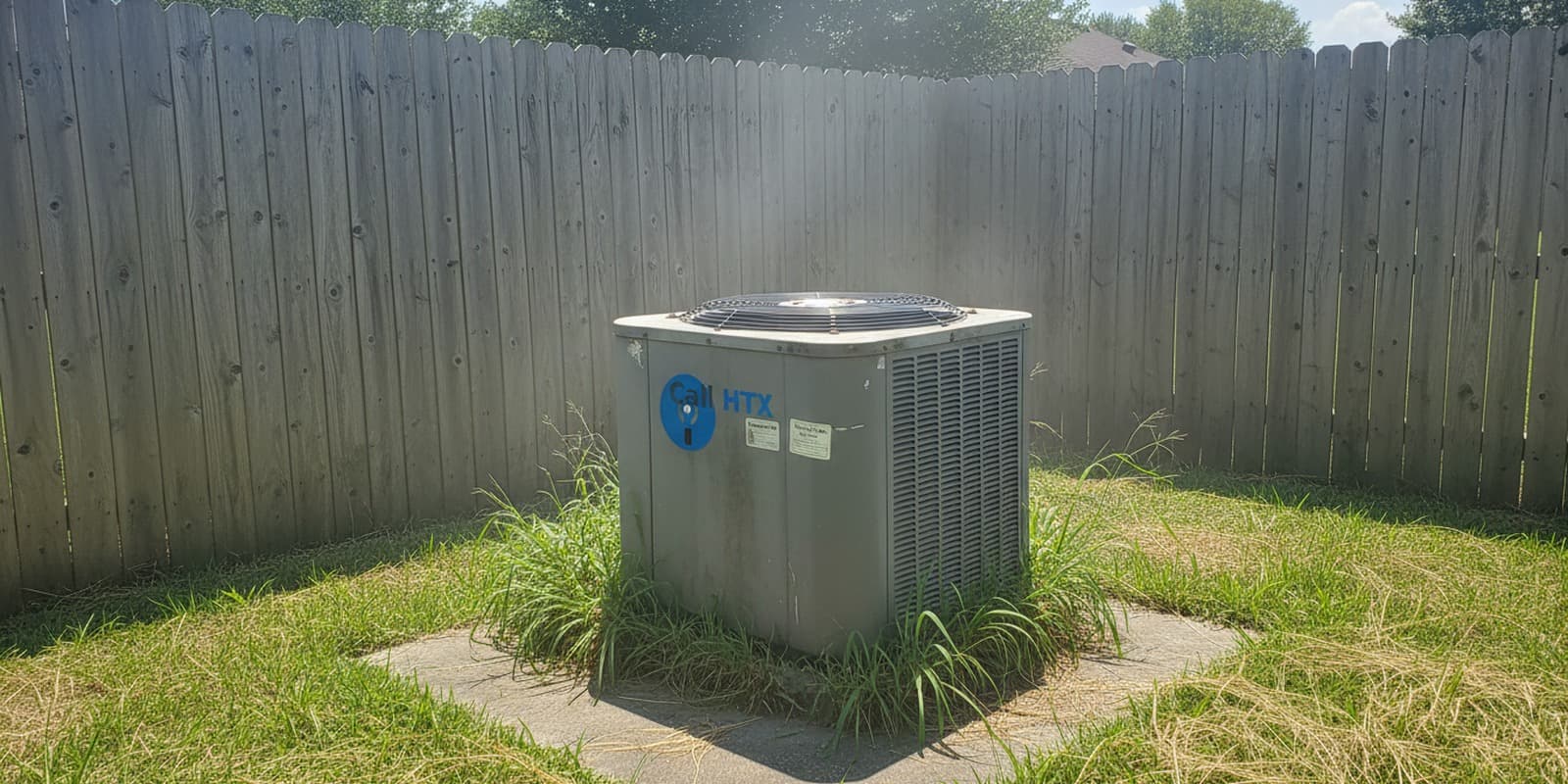
Look at your outdoor condenser unit. Walk outside and look at the large metal unit. Is the fan spinning? Is it running at all? Clear away any debris — grass clippings, leaves, or overgrown vegetation — from the sides and top. The condenser needs at least two feet of clearance on all sides to reject heat properly. In Houston's summer months, a condenser buried in shrubbery will overheat and shut down.
-
Check the condensate drain line. Houston's extreme humidity means your AC pulls enormous amounts of moisture out of your air — often several gallons per day. That moisture drains through a PVC pipe, usually routed to the exterior of your home or into a utility drain. When that line clogs with algae or debris, a safety float switch shuts the system down to prevent water damage. Locate the drain line access port (a T-shaped PVC cap, usually near the air handler), and pour a cup of plain white vinegar into it. If water is backed up, you may need to use a wet-dry vacuum at the exterior drain end to clear the clog.
NOTE: Condensate drain clogs are one of the most common AC failures specific to Houston and the Gulf Coast. The combination of high humidity and year-round system use makes algae growth in drain lines nearly inevitable without regular maintenance.
"A clogged condensate drain line shuts down more Houston AC systems in August than almost any other single cause."
Step 3: Know When It Is Beyond a DIY Fix
If you have completed every step above and your AC is still not cooling, you are dealing with something that requires a licensed HVAC technician. Stop troubleshooting and call for AC repair in Houston.
WARNING: Do not attempt to handle refrigerant yourself. Refrigerant is regulated under federal law, requires EPA certification to handle, and is under high pressure. An improper repair can void your warranty, damage the system further, and create a safety hazard.
Call a professional for any of the following:
- The outdoor unit is running but blowing warm air and the filter is clean
- You hear grinding, banging, or high-pitched squealing from any part of the system
- Your breaker trips repeatedly after being reset
- Ice is visible on the refrigerant lines or the indoor air handler
- The system short-cycles — turns on and off every few minutes without reaching temperature
- Water is actively leaking from the air handler
Temporary Cooling While You Wait for Repairs
HVAC emergency calls in Houston during peak summer can mean waiting several hours for a technician. Use this time to keep your home as tolerable as possible.
TIP: Close off rooms you are not using and keep the household in one cooler area. Fewer people generating body heat in a smaller space makes a meaningful difference.
Immediate steps to reduce indoor heat:
- Close all blinds, curtains, and window coverings on east and west-facing windows
- Turn off ovens, stovetops, and heat-generating appliances
- Use ceiling fans on counter-clockwise (summer) setting to create a wind-chill effect
- Place a box fan in a window facing outward on the hot side of the house to exhaust hot air
- If you have a portable or window AC unit stored away, now is the time to deploy it
- Consider moving everyone to a single room and cooling it with whatever is available
For households with vulnerable members — infants, elderly adults, or those with medical conditions — consider relocating to a neighbor's home, a family member's house, a hotel, or a public cooling center. The City of Houston opens cooling centers at libraries and community centers during heat emergencies.
When to Call for Emergency HVAC Service in Houston
Not every AC failure is a same-day emergency, but some are. Call for emergency HVAC service in Houston if:
- Indoor temperatures have climbed above 90°F
- A medically vulnerable person is in the home
- The system failure is accompanied by burning smells, smoke, or unusual electrical odors
- It is evening or overnight and temperatures are not dropping
CRITICAL: A burning smell from your vents or unit is not a normal AC malfunction. Turn the system off at the thermostat, turn the breaker off at the panel, and call immediately. This can indicate an electrical failure with fire risk.
If your situation is less urgent, scheduling a next-day appointment with a reputable HVAC company is often more cost-effective than paying emergency after-hours rates.
Common Questions
Frequently Asked Questions
Why is my AC running but not cooling?
If your AC is running but not cooling your home, the most common causes are a frozen evaporator coil from restricted airflow, low refrigerant from a leak, or a failing compressor. Start by checking your air filter and making sure all vents are open and unblocked. If those check out clean, you need a technician to diagnose refrigerant levels or a mechanical fault.
How long should I wait before calling an HVAC technician?
Run through the basic troubleshooting steps — thermostat, breaker, filter, condensate drain — and give the system 30 to 60 minutes after any correction to see if it recovers. If nothing changes after that window, call a professional. In Houston summer heat, do not wait more than an hour or two to decide.
How much does emergency AC repair cost in Houston?
Standard diagnostic and repair calls in Houston typically run between $150 and $500 depending on the problem. Emergency or after-hours calls carry additional fees, often $75 to $150 on top of the standard rate. A refrigerant recharge can add $200 to $600 depending on the refrigerant type and amount needed.
Can a dirty filter cause my AC to stop working completely?
Yes — and it happens regularly in Houston. A clogged filter blocks airflow over the evaporator coil, causing it to drop below freezing and ice over. Once the coil is frozen, no air passes through and the system effectively stops cooling. Turning the system off and letting the coil thaw for two to three hours, then replacing the filter, will often restore normal operation.
Should I turn off my AC if it is not cooling?
If your AC is running but not cooling, turn it off at the thermostat and wait 30 minutes before turning it back on. Running a malfunctioning system continuously — especially one with a frozen coil or a refrigerant issue — can cause additional damage to the compressor, which is the most expensive component to replace.
Is it worth repairing a 15-year-old AC unit?
The standard industry guideline is to consider replacement when the repair cost exceeds 50 percent of the unit's value, or when the unit is more than 10 to 12 years old and facing a major repair. A 15-year-old unit in Houston has also likely operated through significant wear from near year-round use, making it less efficient than modern systems.
Houston areas we serve
Ready to get help?
Get trusted help from a trusted source.
License-verified pros we vouch for, open for business in your area.
Get Trusted Help